

Eating Disorder Treatment and Management Plan - A Guide
An Eating Disorder Treatment and Management Plan (EDTMP) is a Medicare-supported treatment pathway for people who meet specific eligibility criteria for an eating disorder.
It can support access to ongoing psychological and dietetic treatment while helping your GP, psychologist, dietitian, and other health professionals coordinate your care.
Who may be eligible?
Eligibility for an EDTMP is assessed by an eligible medical practitioner. You do not need to work out whether you meet these criteria yourself. If you are concerned about your eating, body image or related behaviours, your GP can assess your situation and discuss the treatment options that may be appropriate for you.
People with a clinical diagnosis of anorexia nervosa may be eligible for an EDTMP. For people with bulimia nervosa, binge-eating disorder or other specified feeding or eating disorder (OSFED), additional Medicare eligibility criteria apply.
These criteria consider factors such as the severity and frequency of eating disorder symptoms, physical health risks, other significant medical or psychological concerns, recent hospital admission for an eating disorder, and response to previous treatment. For these diagnoses, an Eating Disorder Examination Questionnaire (EDE-Q) score also forms part of the eligibility assessment.
What treatment can EDTMP support?
An eligible EDTMP can provide access to Medicare benefits for:
up to 40 eating disorder psychological treatment services
up to 20 dietetic treatment services
Psychological treatment is accessed in courses of up to 10 sessions and is reviewed as treatment progresses. Dietetic treatment follows a different referral structure and may include up to 20 services, depending on your individual treatment needs.
Treatment may involve several health professionals, including your GP, psychologist, dietitian, psychiatrist or paediatrician.
When might an EDTMP be helpful?
An EDTMP may be considered when an eating disorder requires structured, ongoing treatment and coordinated care.
This may include situations where you need longer-term psychological treatment, nutritional support, medical monitoring, or care from several health professionals.
Concerns about eating or body image do not automatically mean an EDTMP is the right pathway for you. Your GP or another eligible medical practitioner can assess your symptoms, physical health and treatment needs and discuss the most appropriate options.
Who can prepare an EDTMP?
An EDTMP can be prepared by an eligible:
General practitioner (GP)
Medical practitioner
Consultant psychiatrist
Consultant paediatrician
The practitioner preparing the plan will assess your eligibility and develop a treatment plan based on your clinical needs.
For many people, the first step is an appointment with their GP.


Before Seeing Your GP
If you would like to discuss an EDTMP, let your GP clinic know when booking that the appointment relates to an eating disorder and a possible treatment plan.
Preparing an EDTMP involves a detailed assessment and may take longer than a standard GP consultation. In some circumstances, more than one appointment may be needed.
Your GP may ask about:
Your eating patterns and eating disorder symptoms
Changes in your physical health or weight
The impact of these concerns on your everyday life
Your medical and mental health history
Previous eating disorder treatment
Previous hospital admissions
Other medical or psychological conditions
Medications you are currently taking
For some eating disorder diagnoses, your assessment may also include the Eating Disorder Examination Questionnaire (EDE-Q).
-
If you already know which psychologist or dietitian you would like to see, it can be helpful to bring their name and contact details so your GP can prepare the appropriate referrals.
It is also useful to tell your GP about any other professionals or services currently involved in your care, including psychiatrists, paediatricians, hospitals or public eating disorder services.
-
If you and your treating team think you may require more than 20 psychological treatment sessions, it can be useful to discuss the required specialist review early.
A consultant psychiatrist or consultant paediatrician must contribute to a specialist review before you can access psychological treatment beyond 20 sessions under the EDTMP.
Specialist appointments can sometimes involve long waiting periods, so arranging a referral early can help reduce interruptions to treatment later.
Ensuring your treatment continues
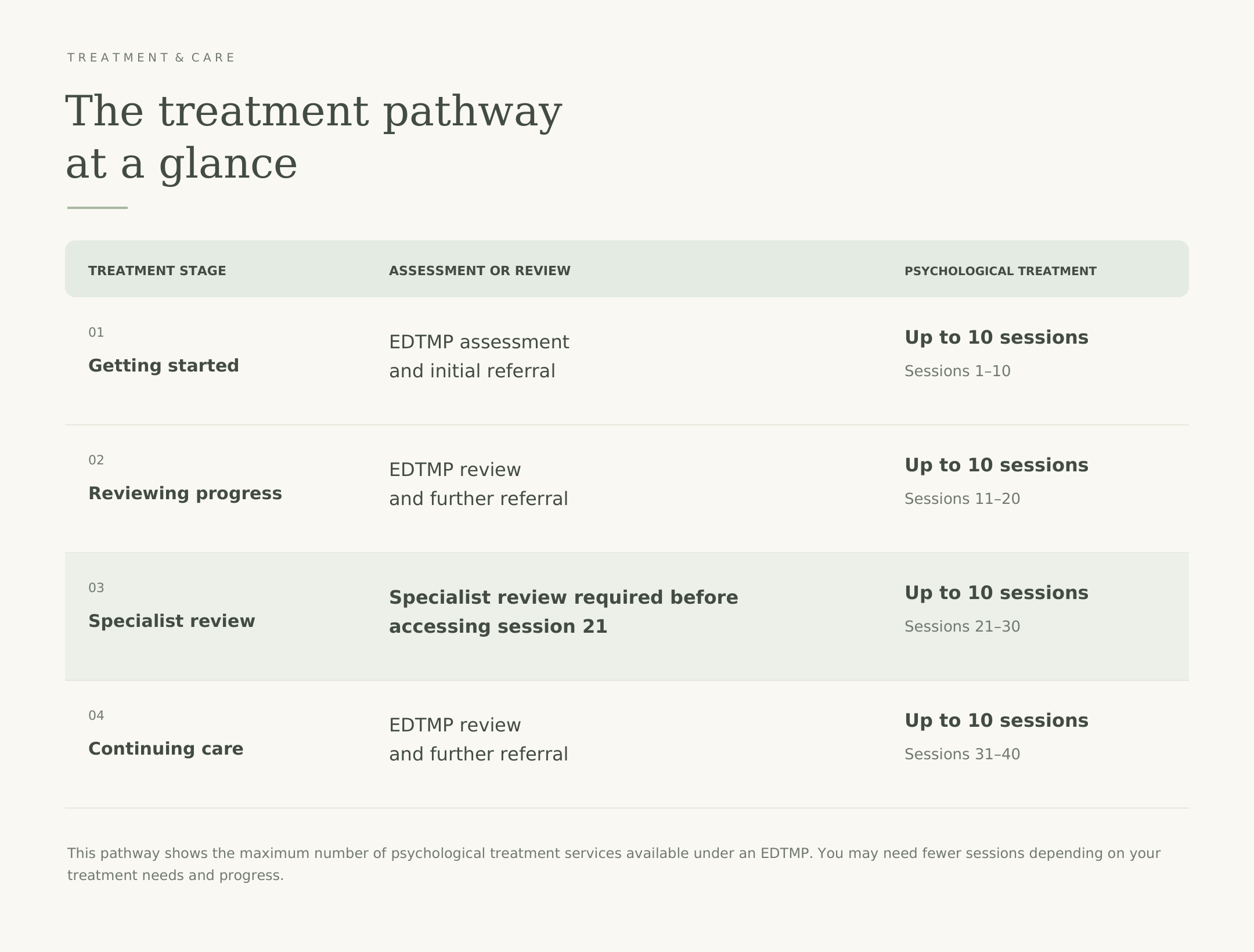
Psychological treatment under an EDTMP is accessed in courses of up to 10 sessions. Your plan is reviewed between courses so your treating team can consider your progress and whether further treatment is appropriate.
Your first 10 sessions
Your initial referral may include up to 10 psychological treatment sessions.
During treatment, your psychologist will communicate with the medical practitioner managing your EDTMP about your treatment and recommendations for ongoing care.
Before beginning another course of psychological treatment, you will need an EDTMP review. If further treatment is recommended, your doctor can provide the next referral.
Before your 21st session
If you need more than 20 psychological treatment sessions, an additional specialist review is required.
This review involves both the medical practitioner managing your EDTMP and a consultant psychiatrist or consultant paediatrician. The specialist considers your progress, engagement with treatment, current needs and whether further treatment under the plan is appropriate.
The specialist review can be completed earlier in treatment. What matters is that it is completed before you access psychological treatment beyond your first 20 Medicare-supported sessions.
After 30 sessions
If psychological treatment is still required after 30 sessions, another EDTMP review is needed before beginning the final course of up to 10 sessions.
Your doctor will consider your progress and treatment recommendations and, where appropriate, provide a further referral.
What if I am already seeing a psychiatrist or being treated through a hospital?
If you are already receiving care from a psychiatrist or paediatrician, including through a public hospital or public health service, ask your treating team whether they can complete the required EDTMP specialist review.
A psychiatrist or paediatrician in the public health system may be able to complete the review if they meet the relevant Medicare requirements and use the appropriate MBS service for the review. A routine hospital or specialist appointment does not automatically replace this requirement.
Medicare, Fees and Your EDTMP
-
An EDTMP allows eligible patients to claim Medicare benefits for approved eating disorder treatment services. It does not necessarily mean that treatment will be free.
Your psychologist or dietitian may charge more than the applicable Medicare rebate, which can result in an out-of-pocket fee.
Before booking, you are welcome to contact our reception team for information about current fees and applicable Medicare rebates.
-
An EDTMP is valid for 12 months from the date it is prepared.
Reviews completed during treatment do not restart or extend this 12-month period. If ongoing treatment is required after the plan expires, a new EDTMP must be prepared before further eating disorder treatment services can be claimed under Medicare.
-
No.
Forty sessions are the maximum number of Medicare-supported psychological treatment services that may be accessed within an eligible 12-month EDTMP.
Treatment is provided in courses of up to 10 sessions and is reviewed throughout the plan. Further sessions depend on your clinical needs, progress and the required reviews and referrals.


Frequently Asked Questions
-
You can attend psychology appointments without an EDTMP. However, Medicare benefits under the EDTMP cannot be claimed until the relevant eligibility, plan and referral requirements have been met.
-
No. The number and frequency of sessions should reflect your treatment needs. Some people will use considerably fewer than 40 sessions.
-
No. The EDTMP itself remains valid for up to 12 months.
What you need during that period are the required EDTMP reviews and referrals for additional courses of psychological treatment.
-
A referral remains valid for the approved number of services while the EDTMP remains current, even if you change eligible health professionals. If you are changing providers, it is helpful to check your remaining sessions and referral documentation before your first appointment with the new clinician.
-
Medicare benefits for EDTMP treatment services cannot be claimed after the plan's 12-month expiry date.
If you continue to need treatment and remain eligible, an eligible medical practitioner will need to prepare a new EDTMP.
Booking with Mind Body Heart Psychology
If you have an Eating Disorder Treatment and Management Plan and would like to access psychological treatment at Mind Body Heart Psychology, please let our reception team know when making your appointment.
If available, please provide:
your current EDTMP
your referral
the details of the referring GP or specialist
information about any other clinicians involved in your eating disorder care
If you are unsure whether your current referral can be used for your next course of treatment, our reception team can review the documentation available to us and let you know if further information is required from your referring practitioner.
If you have not yet obtained an EDTMP, you can speak with your GP about whether an assessment for the plan may be appropriate.
Meet Our Eating Disorder Specialists

Yee Han Wong
Provisional Psychologist

Summer Guo
Clinical Psychologist