
Internal Family Systems (IFS) Therapy
IFS (Internal Family Systems) is an evidence-based approach developed by Dr Richard C. Schwartz to therapy that helps you understand the different "parts" of yourself, and build a calmer, more compassionate relationship with all of them. It is offered at Mind Body Heart Psychology as part of our range of therapeutic approaches, helping clients explore their inner world with curiosity rather than judgment. It's a therapy that suits many different starting points, whether you're processing something difficult from your past, feeling overwhelmed in the present, or simply wanting to understand yourself better.

What is IFS?
We all have different "parts" of ourselves; the part that wants to please others, the part that gets anxious before a big decision, the part that shuts down when things feel overwhelming. IFS is a therapeutic approach that sees this as completely normal, not a sign that something is wrong with you.
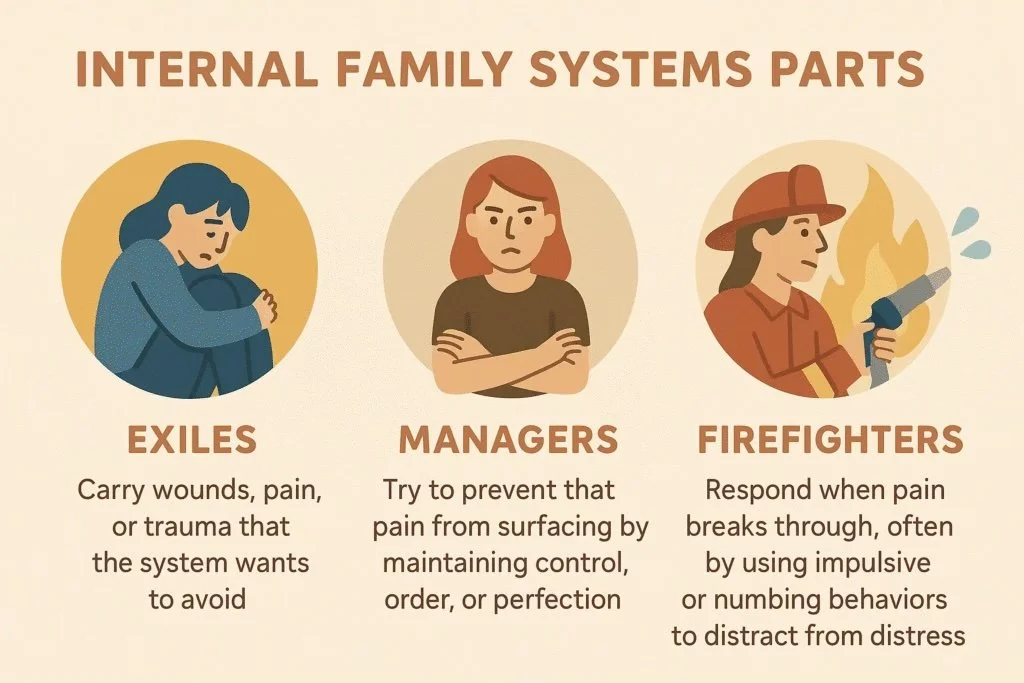
IFS groups these parts into three broad categories:
Managers — the parts that try to keep things under control, often through planning, perfectionism, or people-pleasing.
Firefighters — the parts that step in reactively when pain feels too intense, sometimes through distraction, avoidance, or impulsive behaviour.
Exiles — the more vulnerable, often younger parts that carry pain, fear, or shame, and are usually protected by the other two.
A core idea in IFS is that no part is "bad" or something to get rid of. Every part is trying to help you in its own way, even if its strategy sometimes causes problems. IFS therapy isn't about silencing these parts — it's about understanding them.
The Concept of "Self"
At the centre of IFS is the idea of Self — the calm, grounded core of who you are beneath all your parts. When you're operating from Self, you tend to feel more curious, calm, clear, and connected.
IFS often describes this using the "8 Cs": calm, curiosity, clarity, compassion, confidence, courage, creativity, and connectedness.
The goal of IFS therapy isn't to get rid of your parts; it's to help your Self come forward as the compassionate leader of your internal system, so your parts can trust that they're being heard and no longer need to work so hard.

What to Expect in IFS Therapy?
IFS is a form of talk therapy where you and your therapist work together to identify the different "parts" or sub-personalities that make up your inner world.
Once these parts are identified, your therapist helps you recognise and process any emotions you've been holding back, allowing you to move through them rather than staying stuck. Over time, this creates space to work on the underlying issue itself and build healthier, more sustainable ways of handling conflict going forward.
To support this process, your therapist may draw on techniques such as relaxation exercises, visualization, journaling, or mapping out how your Self relates to your different parts.
Meet IFS Therapist Yixuan Li
